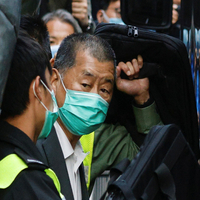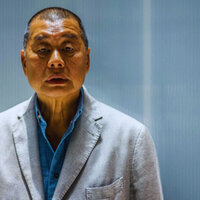



HONG KONG, Feb. 11 (Xinhua) -- A spokesperson for the Commissioner's Office of the Chinese Foreign Ministry in the Hong Kong Special Administrative Region (HKSAR) on Tuesday wrote to the Wall Street Journal (WSJ) to rebut its recent editorial concerning the case of Jimmy Lai.
In the letter, the spokesperson criticized the WSJ for publishing an editorial on Monday titled "Jimmy Lai Gets a Death Sentence" right after he was sentenced to 20 years in prison, describing it as pre-fabricated, biased, fact-ignoring, and severely misleading.
The spokesperson pointed out that fabrication based on speculation oceans away is never a reliable way to write about the events in Hong Kong. The WSJ owes it to the public to rise above the use of clickbait headlines and disinformation.
The spokesperson said the editorial equated in the title the 20-year sentence with a death sentence, which misleads readers into believing that the Hong Kong court has just handed down a death penalty. Hong Kong formally abolished the death penalty back in 1993. The spokesperson further said that perhaps the WSJ should be more worried about the century-long, even thousand-year sentences passed by American courts.
The spokesperson said the editorial suggested that Lai, as a "publisher," deserves some special treatment, if not immunity. But everyone is equal and no crime can escape legal punishment.
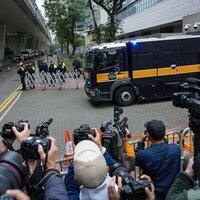
While the editorial decried the sentencing "a profound injustice," the spokesperson stressed that the trial was conducted with full transparency, closely witnessed by Hong Kong people, the media, and foreign consular officials. The proceedings were beyond reproach, the sentencing was grounded in law, and the punishment fits the crime, which is the very embodiment of justice.
The editorial alleged the sentencing "confirms that Hong Kong... is now firmly under the iron boot of Beijing," which only exposed the WSJ's grave misunderstanding of the "one country, two systems" principle implemented in Hong Kong, said the spokesperson.
Hong Kong is part of China, and "one country" has always been the precondition and foundation of "two systems," said the spokesperson, adding that any attempt to undermine "one country" is a crime that violates national security and must be held accountable.
The editorial lamented the "end of an era" for Hong Kong. The spokesperson said that it is the old era of violence and chaos orchestrated by anti-China elements that has ended in Hong Kong. What has begun is a new era of stability and prosperity, where Hong Kong is actively fostering economic growth like a racing horse. In 2025, Hong Kong's economy achieved a series of remarkable figures.
As for the WSJ's insinuation that it may not be in China's interest to get the bad press and opprobrium just for keeping some in prison, the spokesperson said that the Chinese people never provoke trouble, but they are absolutely not afraid of it. Neither bad press nor foul-mouthing can shake China's resolve to act in accordance with the law.
According to a recent report by the American Chamber of Commerce in Hong Kong, 86 percent of surveyed U.S. companies in Hong Kong view the city as a competitive international business hub, 94 percent express confidence in Hong Kong's rule of law, and 92 percent have no plans to relocate their headquarters from Hong Kong. Thus, the spokesperson said WSJ's relocation of its Asia headquarters two years ago created a disconnect, leaving its editorial board detached from reality and driven to fabricate narratives.